Your bookkeeper quit. Now what?
When a bookkeeper leaves unexpectedly, the immediate concern is not finding a replacement as quickly as possible. The first priority is protecting access to your financial systems and determining which responsibilities remain unfinished.
Payroll, vendor payments, customer invoicing, reconciliations, and tax-related deadlines still need attention during the transition. Taking a structured approach will help you prevent missed obligations and give the next bookkeeper a reliable place to begin.
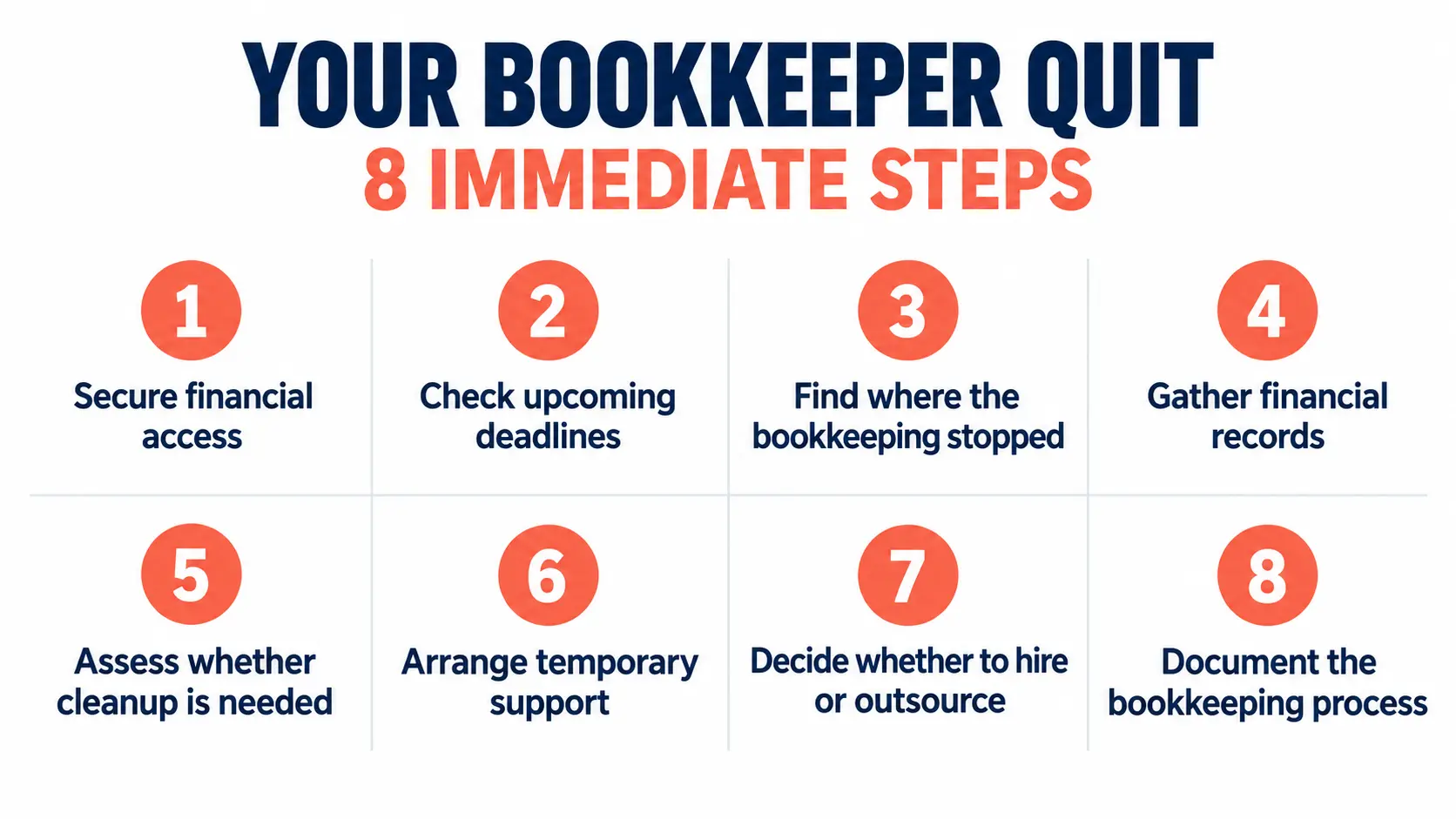
1. Secure access to your accounting systems
Confirm that the business controls the primary administrator account for every financial platform. This includes your accounting software, bank accounts, payroll system, bill-payment platforms, merchant accounts, and shared financial documents.
Make sure the recovery email address and phone number belong to the business rather than the former bookkeeper. Review the current users, their permissions, and the systems they can access.
Do not remove the departing bookkeeper until you have confirmed that another authorized person has administrator access and that the necessary records have been preserved. If you use QuickBooks, review Intuit’s guidance for managing your QuickBooks account and user access.
2. Check your immediate deadlines
Create a calendar of everything that must happen during the next 30 days. Start with obligations that could affect employees, customers, vendors, taxes, or access to credit.
Pay particular attention to:
- Employee and contractor payroll
- Vendor and loan payments
- Customer invoices and payment collection
- Payroll-tax deposits and sales-tax filings
- Bank and credit-card reconciliations
- Month-end reports required by management or your CPA
Do not assume a deadline has been handled simply because the former bookkeeper normally managed it. Confirm its status through the appropriate system, provider, or filing record.
The IRS explains that employer responsibilities can differ depending on the business and provides guidance on employment tax recordkeeping. Contact your CPA, payroll provider, or tax professional if you are uncertain about an upcoming obligation.contact your CPA, payroll provider, or tax professional.
3. Determine where the bookkeeping stopped
Transactions appearing in the accounting system do not necessarily mean the bookkeeping is complete. Bank feeds can import activity automatically even when no one has reviewed, categorized, or reconciled it.
Identify the last completed month for each major account. Then determine when customer invoices, vendor bills, payroll entries, and financial reports were last updated.
Review the balance sheet and profit and loss statement for anything unusual. Uncategorized transactions, old unpaid balances, duplicate entries, and unexplained negative amounts may indicate that the work stopped earlier than expected.
If you cannot establish a reliable cutoff date, have an experienced bookkeeper review the file before anyone begins entering new activity. Continuing from an uncertain starting point can carry existing errors into every period that follows.unreconciled accounts.
4. Gather the records needed for a handoff
The next bookkeeper will need more than access to the accounting software. They will also need information about how the business operates, where supporting documents are stored, and which responsibilities occur outside the accounting system.
Collect the most important records first:
- Current profit and loss statement and balance sheet
- General ledger and trial balance
- Accounts receivable and accounts payable aging reports
- Bank, credit-card, loan, and payroll statements
- Prior tax returns and accountant adjustments
- Month-end procedures and recurring reporting requirements
- List of financial systems, users, and responsible employees
Store these records in a secure location controlled by the business. Avoid sending passwords or sensitive financial documents through unprotected email.
A well-organized handoff allows the next provider to spend less time searching for information and more time resolving the unfinished work.
5. Find out whether the books need cleanup
Before assigning normal monthly work to a replacement, determine whether the existing records are reliable. The business may need catch-up bookkeeping, cleanup work, or both.
Catch-up bookkeeping completes periods that were never finished. Cleanup bookkeeping corrects records that were entered but are incomplete or inaccurate.
Warning signs can include:
- Accounting balances that do not match bank statements
- Reconciliations that are several months behind
- Customer payments that have not been applied to invoices
- Duplicate or uncategorized transactions
- Loan balances that do not agree with lender statements
- Old accounts payable or receivable balances
- Financial reports containing unexplained amounts
Starting routine bookkeeping without addressing these problems can make the file more difficult to repair later. Establish a dependable opening point before moving into normal monthly work.
For a more detailed process, read our guide to catch-up bookkeeping.
6. Arrange temporary bookkeeping support
Hiring a permanent replacement can take time. Interim support can keep essential work moving while management evaluates its longer-term options.
A temporary provider may handle transaction entry, account reconciliation, vendor bills, customer invoices, payroll coordination, or the month-end close. The exact responsibilities should be documented before work begins.
Clarify who can approve payments, who will answer transaction questions, and which deadlines the temporary provider owns. Access should be limited to what the person needs to complete the assigned work.
Temporary support is most effective when it stabilizes the process without making major historical changes before the condition of the books is understood.
7. Decide whether to hire or outsource
Once the immediate situation is stable, consider whether the business still needs the same bookkeeping arrangement.
An internal bookkeeper may be appropriate when daily on-site support is required or the position includes administrative responsibilities beyond accounting. An employee can also be useful when transaction volume supports a full-time role and management wants the function entirely in-house.
Outsourcing may be a better fit when the workload does not require a full-time employee, support is needed quickly, or the business wants coverage that does not depend on one person. An outsourced team can also provide access to broader experience when the books require cleanup or reporting needs have become more complex.
The right choice depends on the volume of work, the systems involved, the level of oversight required, and the reports management expects to receive.
Our guide to outsourced bookkeeping and when it makes sense explains what to consider when comparing the options.
8. Create a process that does not depend on one person
Replacing the bookkeeper may solve the immediate staffing problem. Documenting the process can help prevent the same disruption from happening again.
Document:
- Who owns each responsibility
- Who approves payments
- When accounts must be reconciled
- When the month should close
- Which reports management receives
- Where records are stored
- Who controls administrative access
- How unresolved questions are tracked
- Who communicates with the CPA
- How completed work is reviewed
Management should also receive regular financial reports instead of allowing important financial information to remain with one person.
See Scalingwise’s monthly financial summary and analysis for an example of reporting that provides context beyond standard financial statements.
How Scalingwise can help
Scalingwise can help determine what remains unfinished, bring overdue work up to date, and establish a dependable bookkeeping process.
Scalingwise can help determine what remains unfinished, bring overdue work up to date, and establish a dependable bookkeeping process. We begin by reviewing the current condition of your records so we can identify the most urgent problems and recommend a practical next step.
Getting Your Books Back on Track
Depending on your situation, our team can help with:
- Reviewing the current condition of your books
- Identifying overdue tasks and reconciliations
- Completing catch-up and cleanup work
- Maintaining accounts payable and receivable
- Supporting the monthly close
- Preparing financial statements and management reports
- Documenting recurring responsibilities
- Coordinating with your CPA or tax professional
Ongoing Bookkeeping Support
Once the immediate backlog is resolved, Scalingwise can provide ongoing bookkeeping support to help prevent the same issues from returning. We work with QuickBooks, Xero, NetSuite, Zoho Books, Wave, and other accounting platforms.
Talk to a bookkeeping expert and tell us what happened. We’ll help you determine the next practical step.
What should I do first if my bookkeeper quits?
Confirm that your business controls its accounting software and financial accounts. Then identify upcoming payroll, payment, tax, and reporting deadlines.
How do I know whether my bookkeeping is up to date?
Check when each bank and credit-card account was last reconciled. Review uncategorized transactions, unpaid vendor bills, unmatched customer payments, payroll entries, and the latest completed financial statements. If you cannot confirm their accuracy, arrange a professional bookkeeping review.
Can an outsourced bookkeeper take over unfinished bookkeeping?
Yes. An outsourced bookkeeper can review the current records, identify incomplete work, complete overdue reconciliations, and assume ongoing monthly responsibilities. If the books contain errors or are several months behind, cleanup bookkeeping may be required first.
Should I hire another employee or outsource my bookkeeping?
Hiring may make sense when you need daily, in-house support or the position includes other administrative responsibilities. Outsourcing may be more practical when you need help quickly, do not require a full-time employee, or want ongoing support that does not depend on one person.
How long does it take to transition to a new bookkeeper?
A straightforward transition may take a few weeks. It can take longer when accounts are unreconciled, records are missing, access is unavailable, or previous periods require cleanup. The new bookkeeper should review the records and define the work before providing a reliable timeline.