Your business may have outgrown its current bookkeeping support when reports arrive late, reconciliations remain unfinished, or management can no longer get clear answers from the books.
That does not necessarily mean the bookkeeper is doing a poor job. The company may simply have become more complex than the original role, systems, and processes were designed to support.
SCORE explains that accounting systems need to grow with the business to maintain financial clarity and support better decisions.
Here are seven signs that it may be time to reassess your bookkeeping support.
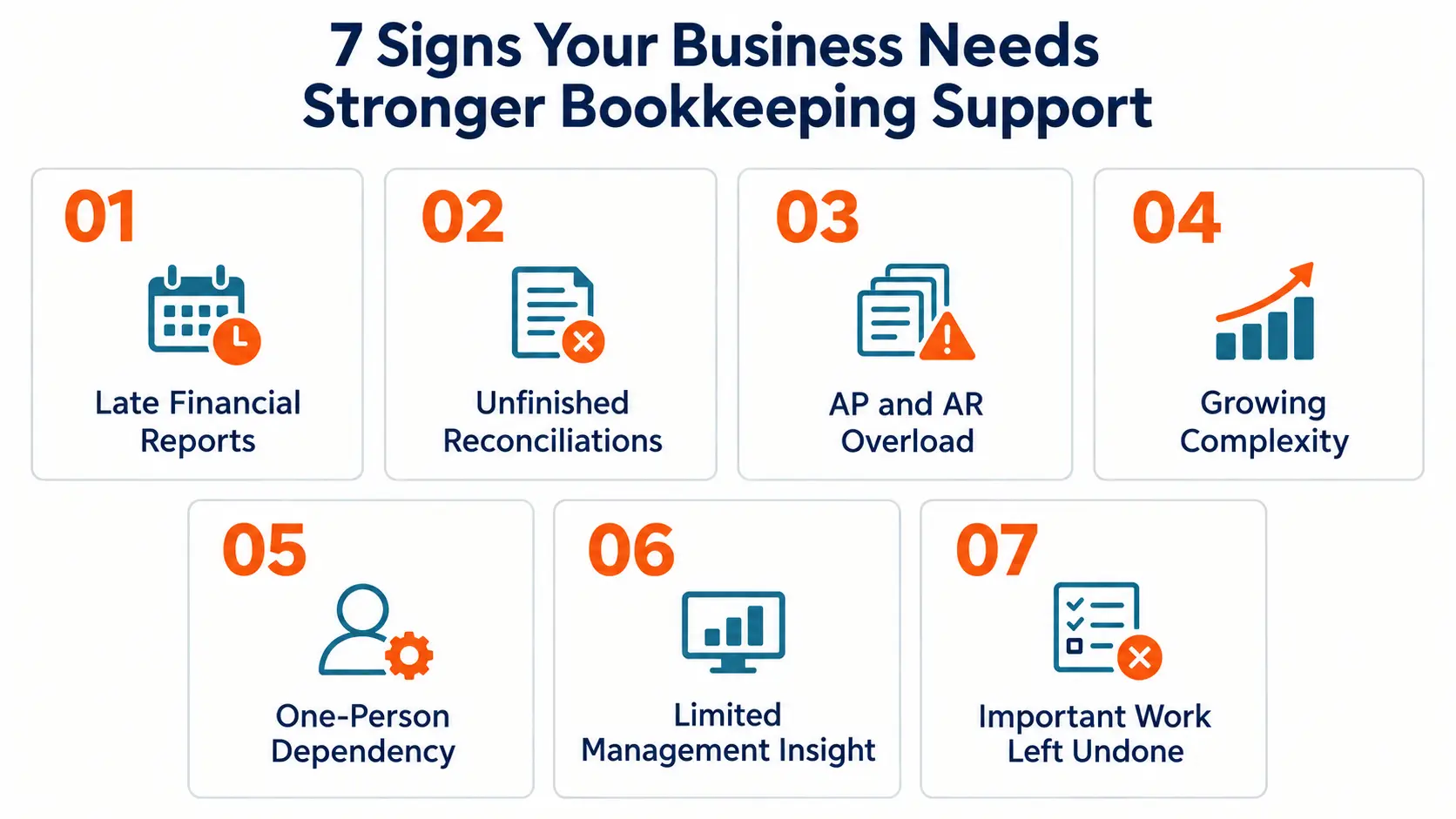
1. Financial Reports Consistently Arrive Late
A profit and loss statement delivered several weeks after month-end may be accurate, but it is less useful for managing the business.
Late reporting makes it difficult to respond quickly to changes in revenue, labor costs, margins, spending, and cash flow. By the time management identifies a problem, another month of activity may already have occurred.
An occasional delay is understandable. Regular delays often indicate that the close process depends on missing information, manual work, or one person with more responsibilities than they can reasonably complete.
A stronger process should define when accounts are reconciled, who reviews adjustments, and when management will receive its reports.
2. Reconciliations and Cleanup Work Keep Accumulating
Bank and credit-card accounts should be reconciled regularly. When reconciliations repeatedly fall behind, management cannot be confident that the accounting records agree with the underlying financial activity.
Other balances can also become unreliable. Loans may not agree with lender statements, payroll liabilities may remain unresolved, and clearing accounts may accumulate unexplained amounts.
Common warning signs include:
- Old unreconciled transactions
- Duplicate or missing entries
- Bank balances that do not match the accounting system
- Transactions left uncategorized for several months
- Unexplained amounts in suspense or clearing accounts
If the same problems return every month, the business may need a better workflow, additional capacity, or stronger review.
Businesses with several unfinished periods can review our guide to catch-up bookkeeping to understand how overdue records are brought current.
3. Accounts Payable and Receivable Are Difficult to Manage
As transaction volume grows, paying bills and collecting customer balances require more than occasional data entry.
Vendor bills must be recorded, reviewed, approved, and paid on time. Customer invoices need to be issued promptly, payments must be applied correctly, and overdue balances require follow-up.
When these processes are inconsistent, cash-flow problems can develop even when sales remain strong. Vendors may be paid late or twice, while aging reports may contain customer balances that are no longer valid.
The bookkeeping process should clearly show what the business expects to collect and what it currently owes. If those answers are difficult to obtain, the company may need additional support.
4. The Business Has Become More Complex
Growth can create more transactions, but it can also create more complicated transactions.
A company may add locations, legal entities, departments, revenue streams, loans, payment processors, or e-commerce platforms. Management may also need to measure performance by project, service, location, or department.
The IRS states that a business recordkeeping system should clearly show income and expenses and retain the supporting documents behind its accounting entries.
As complexity increases, the chart of accounts, monthly close, system integrations, and reporting structure may all need to change. A standard profit and loss statement may no longer provide enough information to manage the business effectively.
5. Too Much Financial Knowledge Depends on One Person
A business faces unnecessary risk when one person controls the accounting systems, understands every process, and holds the only copy of important financial information.
The problem often becomes visible when the bookkeeper takes leave or unexpectedly departs. Payroll, payments, invoicing, reconciliation, and reporting may stop because no one else knows how the work is completed.
This is not about distrusting the bookkeeper. It is about protecting the continuity of the business.
The Association of Certified Fraud Examiners reports that smaller organizations often have fewer checks and balances and less separation of financial responsibilities.
Important procedures should be documented, and administrative access should remain under company control. Another authorized person should understand where records are stored, how payments are approved, and how the monthly close is completed.
6. Management Needs Answers the Reports Cannot Provide
Basic financial statements are important, but growing businesses often need more context.
Management may want to know which services are most profitable, why gross margin changed, how much cash will be needed next quarter, or which customers are consistently late.
These questions may require a better account structure, additional operational data, customized reporting, or financial analysis.
A bookkeeper does not need to act as the company’s CFO. However, the bookkeeping process should produce reliable information that management and its advisors can use.
See our monthly financial summary and analysis for an example of reporting that adds context to standard financial statements.
7. The Bookkeeper Is Always Busy, but Work Remains Unfinished
A dependable bookkeeper can still become overwhelmed when the business grows faster than the financial function supporting it.
The bookkeeper may spend most of the month entering transactions, processing bills, or answering questions. Reconciliations, documentation, reporting, and review are postponed because immediate work consumes all available time.
Replacing the bookkeeper may not solve the underlying problem. The business may need additional capacity, clearer responsibilities, better systems, or support from professionals with different levels of experience.
Routine work may remain with the current bookkeeper while another professional manages the close, reviews balance-sheet accounts, improves reporting, or coordinates with the CPA.
What Stronger Bookkeeping Support Should Include
More support should not simply mean adding another person to enter transactions. It should improve the accuracy, continuity, and usefulness of the financial process.
COSO explains that effective internal controls support reliable reporting, operational objectives, and confidence in business information.
A stronger bookkeeping process may include:
- Clearly assigned responsibilities
- Regular bank and credit-card reconciliation
- Organized accounts payable and receivable
- Documented month-end procedures
- Review of balance-sheet accounts
- Timely financial statements
- Reporting aligned with management’s needs
- Backup coverage during absences or staffing changes
- Coordination with the company’s CPA
The objective is to build a process that can support the next stage of the business without losing accuracy or control.
Should You Replace the Bookkeeper or Add Support?
Outgrowing a bookkeeping arrangement does not automatically mean the current bookkeeper should be replaced.
If the work is accurate but consistently late, additional capacity may be enough. If reports do not answer management’s questions, the business may need stronger reporting or higher-level financial support. When errors continue to return, better procedures and additional review may be necessary.
Our guide to outsourced bookkeeping and when it makes sense explains how outside support compares with managing the work internally.
What to Do Next
Begin by identifying which responsibilities are delayed, where errors continue to occur, and what information management cannot currently obtain.
This assessment will help determine whether the existing process can be improved or whether additional bookkeeping support is needed.
Scalingwise can work alongside an existing bookkeeper, manage selected financial processes, or provide complete outsourced support. We work with QuickBooks, Xero, NetSuite, Zoho Books, Wave, and other accounting platforms.
Complete the form below and tell us what has changed. We’ll help you determine the next practical step.
Does outgrowing a bookkeeper mean they are doing a poor job?
No. The bookkeeper may be performing well while the company’s transaction volume, complexity, and reporting needs have grown beyond the original role.
When should a business add bookkeeping support?
Consider additional support when reports are consistently late, reconciliations remain incomplete, or one person can no longer manage the work reliably.
Should I hire another employee or outsource the work?
An employee may be appropriate when the business needs full-time, daily support. Outsourcing may be more practical when the company needs several types of expertise, backup coverage, or less than a full-time schedule.
Can an outsourced team work with an existing bookkeeper?
Yes. An outside team can support the existing bookkeeper, manage selected responsibilities, complete the monthly close, or prepare reports for management and the company’s CPA.